

How Shadow Liquidity Sustains Al-Shabaab: From Charcoal Exports to Shell Companies
Mapping the hidden financial arteries that keep one of Africa’s deadliest insurgencies alive — from global smuggling routes to potential cryptocurrency adaptations.

Preface
This article was originally drafted and circulated privately in March 2025. Although it was not published through its initial intended outlet, I share it now to advance public understanding of Al-Shabaab’s evolving financial networks and the broader dynamics of illicit liquidity in conflict economies.
This article draws from my Shadow Liquidity Doctrine, first drafted and circulated privately in early 2025. The doctrine defines shadow liquidity and its operational twin, illicit liquidity, as strategic infrastructures that sustain modern conflict, enable gray zone operations, and maintain covert networks of power. Al-Shabaab’s financial architecture exemplifies this hidden circulatory system: an adaptive flow of capital that transcends borders, sanctions, and formal oversight.
Intro
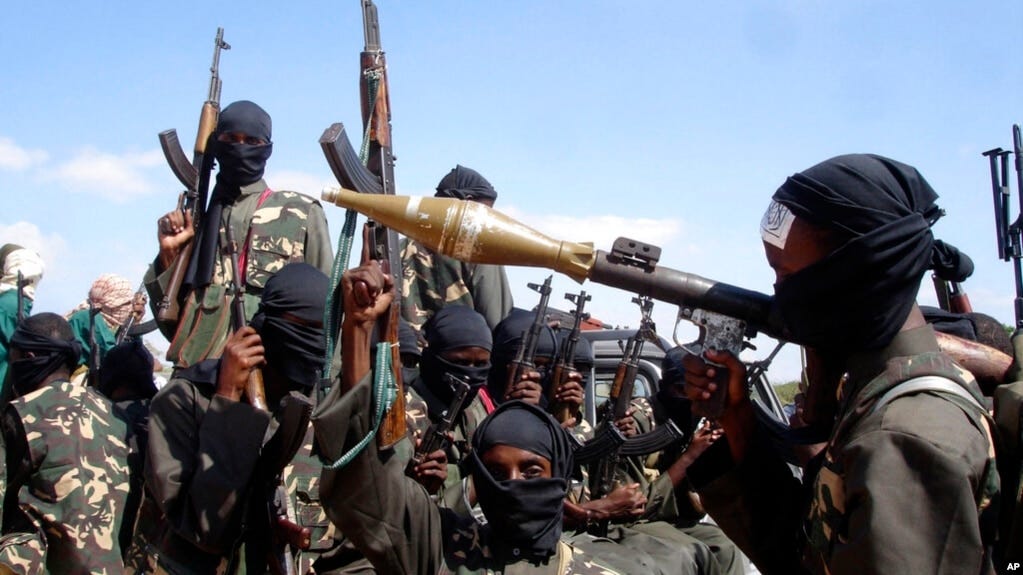
Somali terror group al-Shabaab remains a persistent global threat despite decades of international efforts to combat its influence. With recent reports indicating the militants have established[1] checkpoints just 15 kilometers from the capital, Mogadishu, the al-Qaeda-aligned group continues to launch a dizzying array of attacks, recently striking the Somali presidential convoy and an international hotel in the capital and launching a bomb attack on a US military base in neighboring Kenya last summer – just to name a few. With the African Union Mission in Somalia (ATMIS) ending its mandate on 31 December 2024 and replaced by a scaled-down African Union Support and Stabilization Mission in Somalia (AUSSOM), many in Somalia and abroad have expressed doubts as to the mission’s future success in combating this growing threat.
Sophisticated financial networks underpin much of al-Shabaab’s regional and global threat. These networks are prime examples of what I define as shadow liquidity — hidden capital flows that function as strategic infrastructure, enabling militant and criminal actors to endure despite military or ideological setbacks.
Al-Shabaab’s sustained influence could have severe geopolitical ramifications, given the group’s sway over piracy outfits on the Indian Ocean and close ties to the Houthis and Iran. Last summer, US reports indicated that the Yemen-based and Iranian-backed Houthis had met with members of al-Shabaab to discuss mutual aid, including Houthi arms transfers and technical expertise in exchange for al-Shabaab’s efforts to ramp up piracy of the Somali coast. If successful, this move could extend the current crisis in the Red Sea by thousands of kilometers and more severely impact global shipping, especially if al-Shabaab and the pirate outfits it supports gain access to sophisticated Iranian drones, missiles, and other weaponry. In addition to these potential global ramifications, al-Shabaab poses a significant threat regionally, having carried out devastating attacks killing thousands in Somalia as well as neighbouring Kenya and Ethiopia. In this way, any future al-Shabaab gains could come at a cost to global security as a whole.
Sophisticated financial networks underpin much of al-Shabaab’s regional and global threat. The organization is by far al-Qaeda’s wealthiest constituent group, generating over $100 million USD in revenue annually, funds essential to its deadly operations at home and abroad. Although growing global scrutiny over the past year has hindered al-Shabaab’s financial operations, the group remains tactically resilient, indicating it has and will likely continue to adapt to its constrained financial circumstances. This insight explores how al-Shabaab raises money locally, has harnessed a sophisticated network of financial facilitators and investments abroad to bring money into Somalia, and how it may adapt following new rounds of sanctions by US authorities.
Local Revenue Generation
Al-Shabaab’s revenue generation starts with its territorial holdings, encompassing much of southern Somalia’s Juba River valley. The Juba valley is Somalia’s primary centre for food production, giving al-Shabaab a considerable advantage over the Mogadishu-based federal government. Somalia produces only 40% of its grain requirement domestically, and with most farmland controlled by al-Shabaab, the federal government relies heavily on imports and aid from the outside world at a time when international container ships face a growing threat of pirate attacks off Somali waters. In a country as famine-prone as Somalia, al-Shabaab holds sway over who eats and who does not, giving it considerable power over the populace. Moreover, by holding these lands, al-Shabab extracts revenue from any and all economic activity that occurs on them through heavy taxes levied on commodity exports.
Illicit charcoal production and sales have been al-Shabaab’s most important revenue stream. According to local reports, the group generates between US $8–18 million in annual revenue from a single roadblock that taxes trucks transporting charcoal in the Badhaade District of the Lower Juba Region. In total, al-Shabaab earns an estimated one-third of all revenue generated by charcoal production in Somalia – some US $38–56 million annually. However, these figures date from 2013, and the group’s revenue may be currently much higher. The largest markets for Somali charcoal include the United Arab Emirates, Kuwait, Egypt, Saudi Arabia, and Lebanon. Shisha smokers especially prize Somali charcoal due to its distinct acacia wood aroma, and Chinese e-commerce giant Alibaba ships the product worldwide on behalf of numerous online sellers.
Both al-Shabaab and the Somali Federal Government generate significant revenue from illicit charcoal exports, with government-imposed roadblocks in the capital also collecting taxes on cargo trucks coming from al-Shabaab-controlled territories. For this reason, controlling exports from within the country is practically impossible. According to a 2018 report, al-Shabaab works closely with Iran to facilitate charcoal exports, shipping goods under false country of origin certificates from Comoros, Côte D’Ivoire, and Ghana to ports in Iran, wherein local agents package and resell the product under a ‘Product of Iran’ label. These factors obfuscate the true origin of much of the charcoal on the global market. Reports also indicate that al-Qaeda, al-Shabaab’s parent organization, bases much of its operations in Iran with the central organization’s de-facto chief, Sayf al-‘Adl, reportedly living openly in Tehran. In this way, al-Qaeda Central may facilitate and benefit from illicit Somali exports to Iranian shores.
Other means by which al-Shabaab generates revenue locally include trans-Saharan human and narcotics trafficking, as well as kidnapping foreign nationals for ransom, important sources of foreign currency that it uses to purchase weapons and other goods. Reports indicate that al-Shabaab purchases much of its supplies from coastal pirate rings, requiring cash to do so. Estimates of the group’s total fighting force vary between 5,000–14,000: feeding, clothing, and arming these individuals and paying them enough to support their families requires a steady flow of cash in one of the world’s poorest countries, meaning al-Shabaab must take an active role in Somali export markets and invest globally to generate stable sources of hard currency.
International Financial Networks and Adapting to New Constraints
The United States Treasury Office of Foreign Asset Control (OFAC) and other entities heavily sanction al-Shabaab, limiting its access to the global financial system; given al-Shabaab’s reliance on commodity exports and Somalia’s limited cash economy, the group has had to work with external financiers to bring cash onto Somali shores. According to OFAC, the Dubai-based Haleel Holdings LLC and Qemat al Najah General Trading have been the primary facilitators of al-Shabaab’s global financial operations. The former operates branches in several countries to export Somali goods, transfer money, and make investments on al-Shabaab’s behalf. However, with OFAC slapping these firms with new sanctions last May, al-Shabaab now faces significant challenges in receiving funds from abroad. This development will likely cause the group to adapt.
Haleel Holdings operates a vast network of regional offices in the UAE, Cyprus, Kenya, Uganda, and Somalia. Prior to its 2024 OFAC designation, the company had avoided restrictions for many years despite significant international pressure and scrutiny. For example, in 2019, Ugandan courts cleared the firm’s local foreign exchange and commodities trading division, Haleel Commodities, of charges associated with financing terrorism despite considerable pressure from US authorities and the Ugandan Financial Intelligence Agency (FIA).
According to reports, Haleel’s financial nexus served as interlocutors between al-Shabaab and local businesses in Somalia – likely helping these businesses export commodities such as charcoal and apportioning some of the revenue to al-Shabaab as a form of taxation. Using al-Shabaab funds, Haleel oversaw foreign revenue-generating investments, such as the Kenya-based Crown Bus transport company, which the US also claims helped facilitate al-Shabaab’s logistical operations. Last year’s OFAC sanctions on al-Shabaab facilitators targeted 15 other companies linked to the terrorist group, investments likely facilitated by Haleel. The company likely funneled some of the profits back to al-Shabaab’s Somali operations via hawala. These informal financial networks covertly transfer as much as $300 billion USD worldwide annually. Haleel also provided other services to al-Shabaab, including weapons procurement and recruitment.
By designating Haleel and other companies related to facilitating al-Shabaab financial activities, US authorities have effectively blocked these companies’ access to global fund transfers and asset holdings while adding increased scrutiny by local authorities. Although these facilitators may turn to informal means, such as hawala networks, to transfer funds back to al-Shabaab, they will likely face considerable challenges moving forward, given their inability to access legitimate funding sources. While this is a positive development for countering al-Shabaab’s growing influence, the group’s considerable resources in Somalia and longstanding ingenuity will likely result in its financial adaptation moving forward. For this reason, global law enforcement agencies and tech companies should monitor the situation closely.
Under current levels of scrutiny from Washington, al-Shabaab’s financial path forward will not be an easy one. However, the group has likely already adapted to some degree. In the past, al-Shabaab generated money through fraudulent charitable donations set up across the vast global Somali diaspora community, including from within the United States, receiving funds from witting and unwitting donors. The fundraisers, often women, sent remittances to Somalia broken into small amounts to avoid suspicion. In 2011, an American jury found two female US citizens of Somali origin from Rochester, Minnesota, guilty of providing material support to al-Shabaab. In 2017, a Virginia court successfully prosecuted a similar case involving two Somali-American women linked to al-Shabaab fundraising. In both cases, the women formed part of a global fundraising network, including operatives in Somalia, Kenya, Egypt, the Netherlands, Sweden, the United Kingdom, and Canada. These women and others provided financial support to al-Shabaab at the time through traditional cash remittance companies. With today’s mobile remittance providers more widespread and sophisticated cryptocurrencies also more readily available, al-Shabaab could attempt to solicit donations from global donors in larger amounts now that US authorities have placed the group’s primary financial facilitators under heavy restrictions.
Al-Shabaab could also solicit donations via digital currencies, especially those with enhanced privacy protections such as Monero. The group could also leverage al-Qaeda’s vast global propaganda apparatus, which operates extensively in places where local regimes likely provide haven for its activities, such as Afghanistan, Iran, and Yemen. Al-Qaeda’s chief global rival, the Islamic State, has pioneered this fundraising model, and, given its success, al-Qaeda affiliates like al-Shabaab could adapt it for their own purposes moving forward. Moreover, given the high levels of scrutiny on al-Shabaab financiers who transfer cash and make investments via traditional means, digital currency transfers to new external financial facilitators are likely, given the significant revenue al-Shabaab generates from commodity exports. Finally, al-Shabaab will likely increasingly turn to criminal activity to finance its operations, including kidnapping for ransom, as well as human and narcotics trafficking, to finance its operations. The group kidnapped five Kenyan officials from the Kenya-Somalia border order region of Mandera County in February, and such incidents could become increasingly commonplace.
Recommendations
Al-Shabaab will likely take a multifaceted approach to its increasingly constrained financial circumstances. Ensuring this terror group, one of the world’s four deadliest, remains restricted from accessing global funds will require technology companies to remain vigilant and closely collaborate with law enforcement agencies. Companies can also explore long-term and short-term measures to combat financial operations by al-Shabaab and other groups.
In the short term, global remittance providers and digital currency exchanges should closely monitor suspicious transactions, especially in East Africa. These organizations should also work to compile comprehensive, human-curated datasets containing suspicious transactions that may be shared with law enforcement when required. The Financial Action Task Force (FATF) has released a comprehensive guide to countering terrorist crowdfunding campaigns, noting these groups’ propensity for using cryptocurrencies with enhanced privacy features such as Tether and Monero. Last year, the Japanese National Police Agency’s Special Cyber Investigations Division arrested an individual suspected of conducting money laundering activities using Monero. Although the agency has not commented on their exact methods, they did indicate that they used the suspect’s records from communication apps, credit card transactions, and suspected Monero transactions. This landmark case may prove an invaluable blueprint for global law enforcement agencies and technology companies to compile as much data on suspicious transactions as possible to share with these potential investigations.
In the long term, service providers such as e-commerce platforms and blockchain companies should explore ways to improve the verification of supply chains associated with goods used to finance terrorism, such as charcoal. Current estimates place the value of the global charcoal market at just over $8 billion USD, making Somalia’s illicit and environmentally unsustainable exports a small fraction of this total, and thus difficult to track internationally. Given al-Shabaab and its partners’ talent for obfuscating the true origin of their goods, cutting off funding to this deadly terror group demands a more technical approach. Blockchain verification systems could be an important step in the right direction as they offer a tamper-proof, efficient, and transparent means to verify the legitimacy of exports and imports at each journey step.
For example, a legal and compliant Indonesia-based charcoal supplier would upload a public, secure stamp verifying the legal shipment of goods from their facility to the nearby port of Tanjung Parek in Surabaya. Agents at both this port and its destination port in Jeddah, Saudi Arabia, would also upload their own secure stamps, as would the buyer upon delivery, with each individual contributing to a record of the product’s legal supply chain in the form of a publicly accessible digital ledger. Any individual or group seeking to commit fraud by selling illegally sourced goods through legitimate channels would do so publicly and transparently, greatly heightening their personal risk for doing so. In this way, e-commerce retailers and their compliance teams could rest assured of the near-zero risk that the goods sold on their platforms finance terrorist groups like al-Shabaab. By investing in such products, companies may also come ahead of future compliance requirements regarding counter-terrorist financing related to goods sold on their platforms.
Finally, hawala systems present the single largest frontier in counter-terrorist financing. Countering terrorist activity through these networks requires financial institutions and transfer apps to keep close tabs on suspicious activity that may be timed with illicit hawala transfers, as many hawaladar (hawala transfer agents) use legitimate means to settle their accounts. In the longer term, offering low-cost and accessible solutions to the world’s vast unbanked population of some 1.4 billion people is the best way to add transparency and accountability to this vast, unregulated, informal global remittance system. Many companies and governments across Africa have invested in such products, and global technology companies should consider further investing in new ways to enhance access for the globally unbanked. With hawala currently accounting for as much as $300 billion in transfers annually, there is a clear profit incentive to offering more accessible and lower-cost options than this vulnerable population can access through their local hawaladar. By limiting the flow of legitimate money through Hawala networks, providing services to the global unbanked population ultimately limits the cover provided to bad actors such as criminals and terrorist groups, who also use Hawala to finance their activities.
Conclusion
Al-Shabaab’s survival depends not only on ideology and violence, but on its ability to maintain and adapt its shadow liquidity networks. For a deeper exploration of these hidden financial infrastructures and their strategic implications globally, see my Shadow Liquidity Doctrine.