


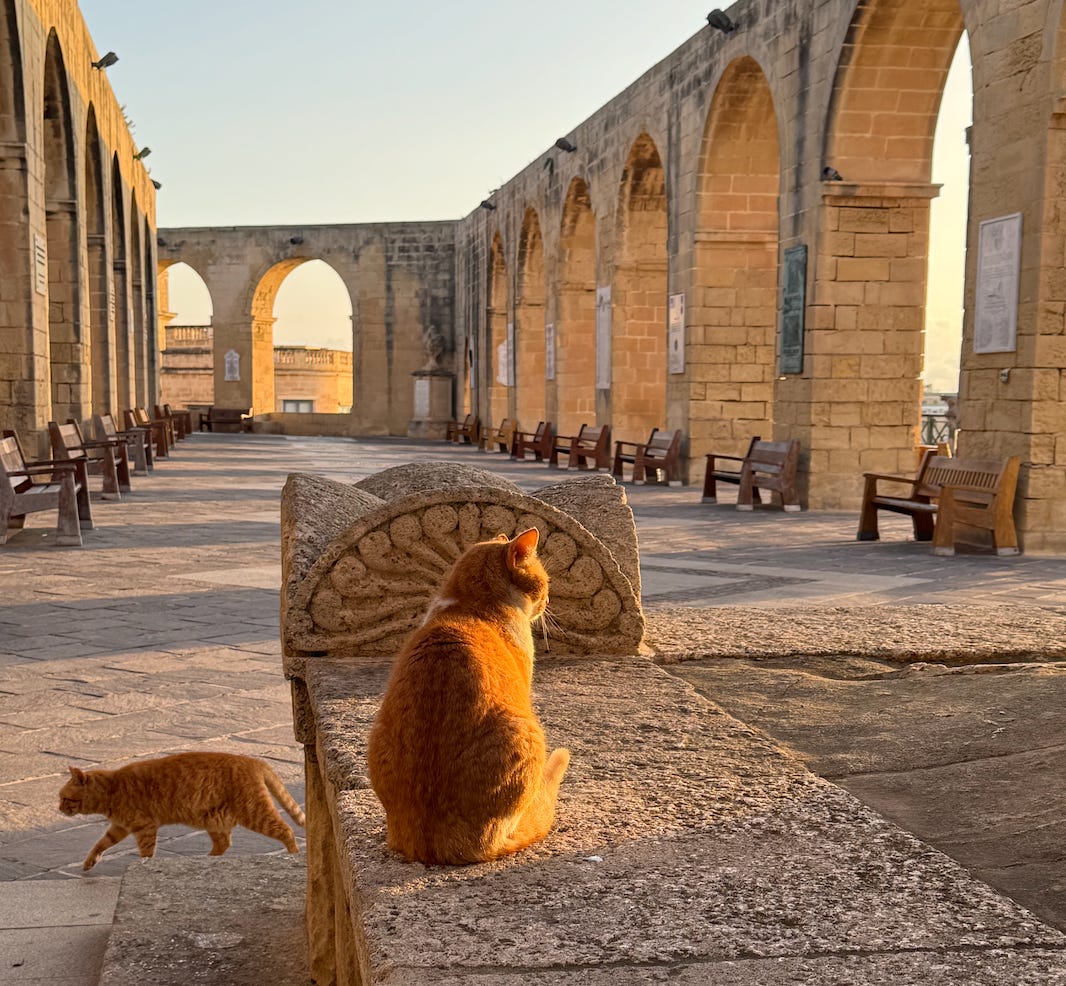
Sometimes life brings you to a crossroads, as demonstrated to me one morning in Malta by these two cats looking in opposite directions. The picture reminds me of the painting from Goodfellas.
Dear subscribers,
It has been a while since I last posted. Thank you for sticking around. I want to explain why my work has changed, what I’m working toward, and why future research will be behind a paywall.
Why threat finance?
Some of you subscribed for the broader geopolitical and economic analysis I used to publish. My increasing focus on threat finance may seem like a departure. For me, it grew out of a problem I kept encountering: we can identify who moved money and what it financed, yet struggle to explain why the networks behind those transactions keep surviving.
Much of the analysis I read follows particular payments, funding sources or sanctions violations. I wanted to understand the system that makes them possible. What allows a network to replace a frozen account or a sanctioned intermediary and carry on?
I spent a substantial part of my career analysing commodities. In that business, you need to understand what makes a flow possible: who finances it, who arranges the trade, and how policy or events elsewhere affect it. A shipment or a price tells you very little on its own – even less when it comes to predicting outcomes, which is what the clients ultimately demand.
Applying that lens to global grey finance, or “shadow liquidity,” has been alarming and personally transformative. Parallel financial systems already sustain vast criminal economies, armed groups and state-linked intelligence and procurement networks – including those linked to nuclear weapons proliferation. They allow actors to mobilize resources and exercise power beyond the reach of institutions meant to constrain them.
My Parallel Trust framework examines how the relationships holding these systems together form and survive disruption. My complementary Three Tier Framework examines the directionality of these flows, including their source drivers and the intermediaries that make them possible through parallel trust. If the trusted intermediaries and connections remain, closing a financial channel may simply move the activity elsewhere. As these systems expand, they threaten the state’s ability to regulate finance and constrain organized violence. That has consequences for the international order far beyond any individual laundering case.
Where the work has gone
Over roughly the past eighteen months, my research has been cited by:
The Financial Action Task Force (FATF)
The U.S. Senate
The U.S. Congressional Research Service
The Africa Center for Strategic Studies, a U.S. Department of Defense institution
The United Nations
The German Bundestag
A Coinbase submission to the U.S. Treasury.
My three-part Islamic State finance series received seven citations in FATF’s 2025 comprehensive update on terrorist financing, making me its most-cited individual source.
In April, I presented my Parallel Trust framework to the United Nations Security Council’s Counter-Terrorism Committee Executive Directorate (CTED). I explained how propaganda builds the credibility and trust needed for financial and operational coordination, before a transaction becomes visible.
CTED’s September report cited that briefing and incorporated the framework into its analysis of propaganda as operational infrastructure. It also included five of my articles and the briefing announcement in its counter-terrorist-financing reference database.
I’m proud of that. I wanted this research to be useful, and there is now a record of institutions using it. With any luck, this work and its legacy will outlive me, a man with no children at the dawn of middle age.
What that hasn’t paid for
The income has not followed.
I have continued researching while taking side jobs and pitching commissions, including to institutions already familiar with my work. Some of the most prestigious organizations on earth expect consultations for free. I have travelled around the world twice to attend conferences, with transport and accommodation covered but no payment for my time or contribution.
I cannot keep working that way. Checking evidence, following networks and developing an explanation that holds up to scrutiny take time. A citation does not pay for it, however pleased I am to receive one.
That means changing how I publish. I can no longer afford to develop substantial original work and then compress it into a short article for a few hundred dollars. Subscriptions and properly funded commissions will need to support the research.
What changes here
Future research articles on Between the Lines will be for paid subscribers. Most articles that are currently free will stay free.
I have raised subscription prices to reflect the work involved, while keeping monthly and annual options within reach of individual readers.
There is still a great deal I want to publish. I will be examining the machinery behind shadow liquidity, including the states that deliberately use parallel systems and those that help create them through policy failures or gaps in enforcement.
Readers interested in my broader geopolitical work will find those questions running throughout. Following these systems means examining how states exercise power, how armed groups sustain themselves and how seemingly distant conflicts become financially connected.
For institutional readers
The higher-priced Founding Member tier is intended for institutions. If you are an individual reader, a regular paid subscription gives you access to the research; you do not need to pay the institutional price.
Institutional subscriptions include a 30-minute consultation to discuss the research and its relevance to your work. Commissioned reports, training and ongoing advisory work are separate engagements, with their own scope and fee.
I remain interested in paid institutional partnerships, and several discussions are underway. But Between the Lines also needs to support work I can pursue independently, without waiting for an institution to commission it.
Thank you to everyone who has subscribed, shared an article or brought the research to someone’s attention. I have much more to say, and I want to be able to give it the time it deserves.
Adam